
For science to be meaningful it has to be built upon the right foundation.
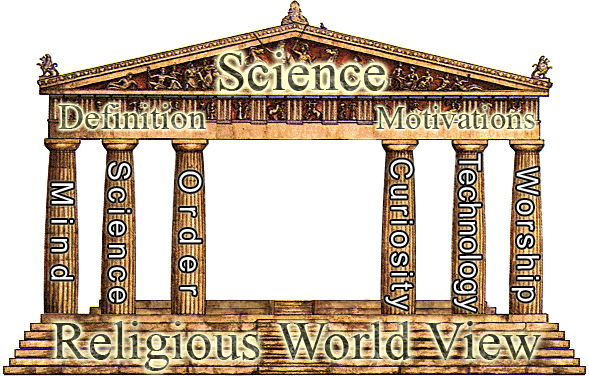
You need to make several basic assumptions about reality and about yourself before you can ever begin to use the scientific method. You also need motivation to do science, and moral direction for applying technology to the real world. The Christian Worldview provides all of these things better than any other religious worldview, especially Atheism. In fact, science without God is meaningless.
Basic Assumptions
Science comes from the Latin scientia, meaning “to know.” Science is a search for knowledge about how the natural world works. Why do you believe that we can perceive and understand the order in nature? Why do you believe we can transcend nature enough to manipulate it in experiments? How can we trust the very thoughts we are thinking and any conclusions we come to? Why believe that we can “know” anything about nature at all?
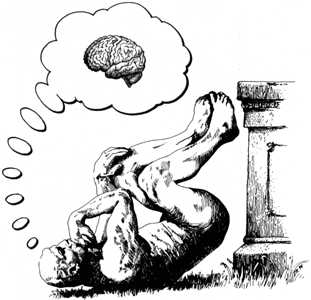
For the Atheist, man is nothing more than a small part of the great cosmic machine. For him, our seemingly free will to choose what to observe in the lab or what to focus our microscopes on are not free choices at all, but rather are predetermined events in the great chain of cause and effect going back all the way to the Big Bang. For the Atheist,every ingenious scientific thought and every creative technology in the history of science can in theory be completely reduced to three pounds of organic chemicals that arranged themselves by chance over billions of years producing behaviors with one goal, to survive and reproduce.
As the biologist, J.B.S. Haldane, put it, “For if my mental processes are determined wholly by the motions of atoms in my brain I have no reason to suppose that my beliefs are true. They may be sound chemically, but that does not make them sound logically. And hence I have no reason for supposing my brain to be composed of atoms.”
On the other hand, in the Christian worldview, Man was created in the image of God with the abilities to think, reason, question, and create. Therefore, we have reason to trust our ability to attain knowledge and we can expect to discover Truth about nature.
As C.S. Lewis said, “He is the source from which all your reasoning power comes: you could not be right and He wrong any more than a stream can rise higher than its own source. When you are arguing against Him you are arguing against the very power that makes you able to argue at all: it is like cutting off the branch you are sitting on.”
Similar arguments could be made for other assumptions needed for meaningful science such as:
- The reliability of our five senses to observe nature.
- The freedom to choose which sensations and thoughts to focus on in an experiment.
- The assumption that nature is real and not merely an illusion.
- The assumption that there is order to be discovered in nature, so much order that we can describe it using simple, elegant, mathematical formulas.
- The order we observe here and now can be applied to other times and places.
- We can’t simply predict how nature is ordered, we must go out and see for ourselves.
Should we believe in each one of the above assumptions as separately, ultimately true even though they are each different, unrelated, and totally independent of one another? Or should we believe in one assumption as the Ultimate Truth, that can explain all of the others in a way that relates them to each other perfectly and makes them each fit beautifully into one and the same story? In this sense, the time-honored maxim of science, “Ockham’s Razor,” supports the Christian worldview better than Atheistic Humanism. As Ockham’s Razor says, All things being equal empirically, the simpler explanation is the better explanation.
Motivations
And how about the motivations for doing science? Every scientist knows well that without strong motivations for studying nature, the hard work of research would never get done. Throughout history there have been three major motivations for doing science:
- 1. Satisfying Curiosity
- 2. Developing Technology to Benefit Mankind
- 3. Bringing Glory to the Creator
For example, which serves as a better inspiration of wonder and curiosity, Atheism or Christianity? In Atheism, one day in the relatively near future, all the knowledge and technology that we work so hard for will be lost and forgotten forever. In Christianity, what we do here and now can affect people who will go on to live forever. Our understanding and use of the creation can draw us nearer to the One and Only Creator of the Universe, which will pay off eternally. That’s amazing!
In summary, science built upon Atheism is doomed to collapse in on itself. On the other hand, the Christian Worldview is the simplest and strongest foundation to support the basic assumptions and motivations we all need for doing science. Let’s face it, science without God is meaningless!
For more information:
- Meaningful Science Study Guide
- Meaningful Science Study Guide Answer Key
- “The Biblical Roots of Modern Science” by Jonathan Sarfati
- “Christianity: Cause of Modern Science?” by Eric Snow
- “Christianity and the Origin of Modern Science” by John Millam
- “Is Science a Threat or Help to Faith?” by J.P.Moreland
- A Meaningful World by B. Wiker & J. Witt
- The Anti-Naturalism Page of Dr. Sloan Lee
- Debate Between William Lane Craig and Antony Flew!
Possible Worlds
Mere Christianity
Recent Comments